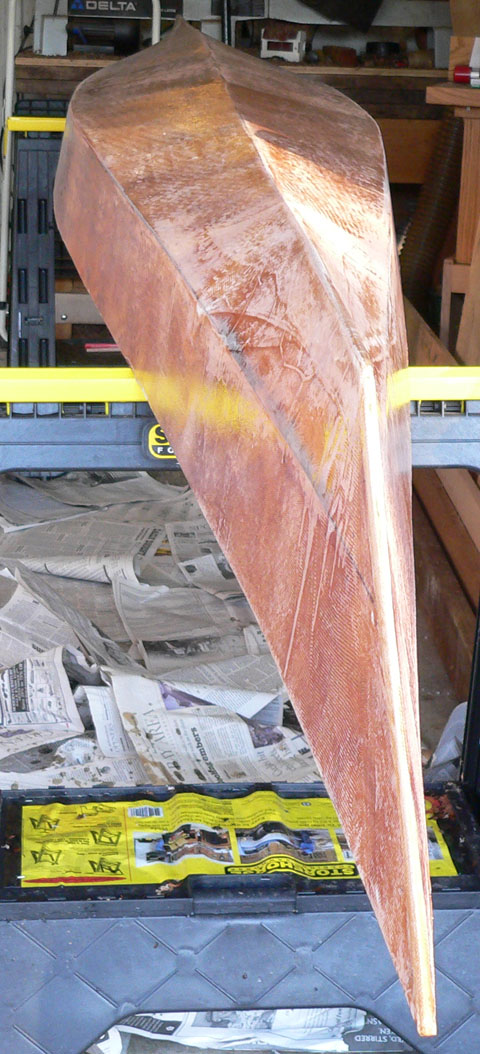
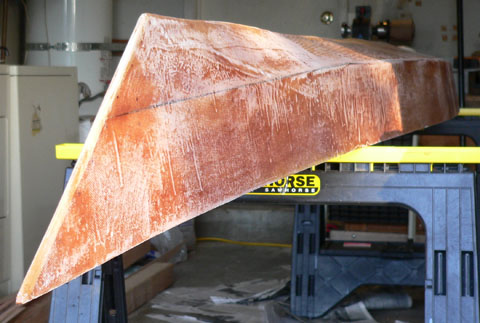
Build Log For My Squeedunk Cormorant
In the fall of 2004, I was working at a tech company for the first time since the dot bomb in 2001. I spent a lot of time talking about kayaking and building a new kayak. One of my co-workers challenged me to get going on the project. That provided incentive for me to begin looking for a fairly easy design, as I had already bought a set of plans which looked a bit too complex for me to start without some practice. this boat is the result.
The Squeedunk company provides offsets for a stitch and glue version of their Cormorant 16 free of charge on their company web site. I downloaded the plans, bought some marine plywood and got to work. I plan to make a hybrid version of the boat. That means stitch and glue for the hull and strip build for the deck. The rational for this is simply that strips are much prettier, and thus should be used on the deck which is going to be visible when the boat is in the water. It's also easier to strip the relatively flat deck as apposed to the compound curves of the hull.
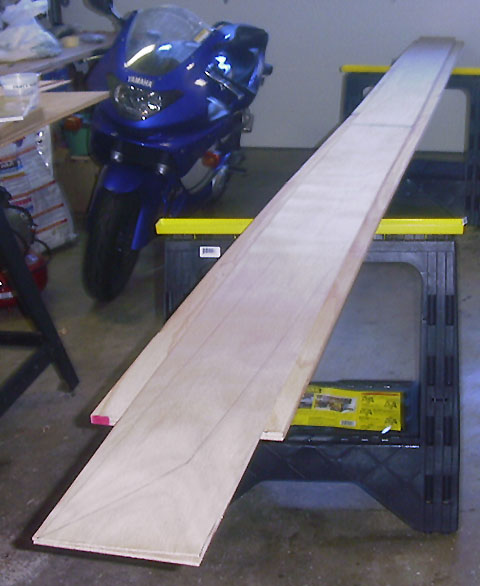
The first thing one does with a stitch and glue kayak is to lay out the various panels and cut them to size. I was not prepared to join two full sized pieces of floppy marine plywood together all at once, so I measured the sizes I would need, cut the plywood into strips of the proper width and scarfed them together to make the longer strips required for my panels.
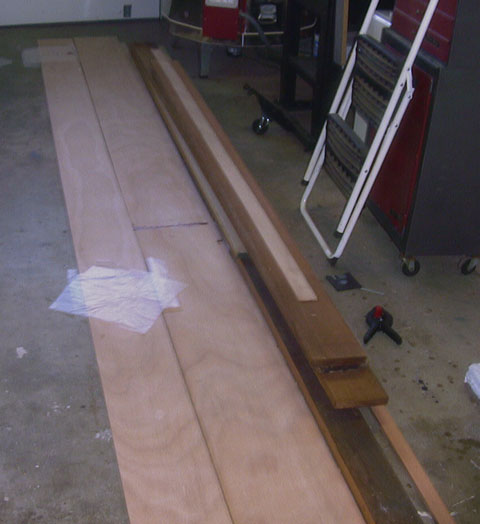
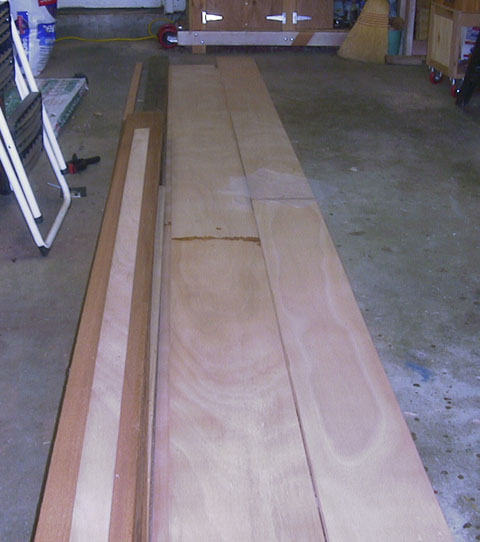
Panels scarfed together

Another shot of the panels

This shot shows the outline of one of the panel sets drawn on the plywood prior to cutting.
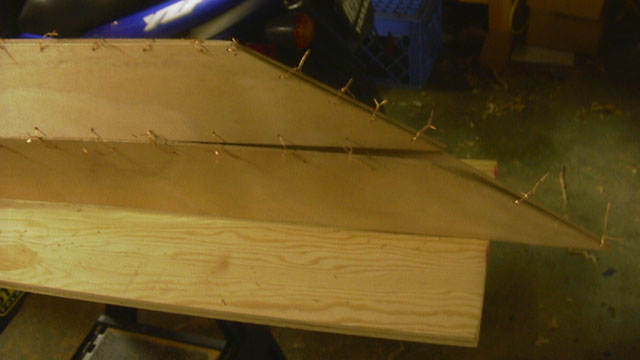
After the panels have been cut to shape, holes are drilled along the sides and they are stitched together. I used copper wire for this. Some people use steel wire, some use zip ties. It doesn't really matter what you use as long as the task is accomplished to the satisfaction of the builder. Here are some pictures of the partially stripped boat, presented in no particular order.
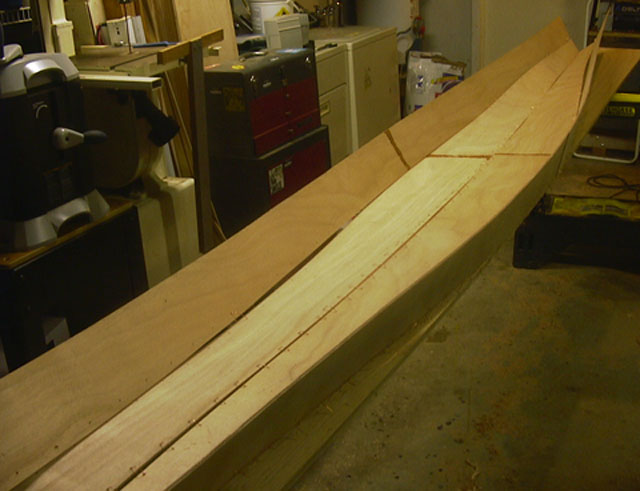
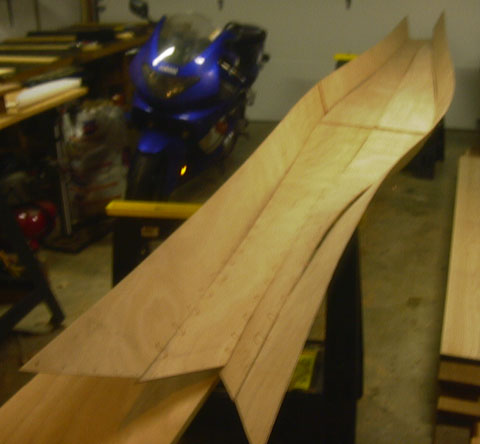
Panels stitched together except for bow and stern ends.

Another pic of the ends flapping in the workshop breeze.

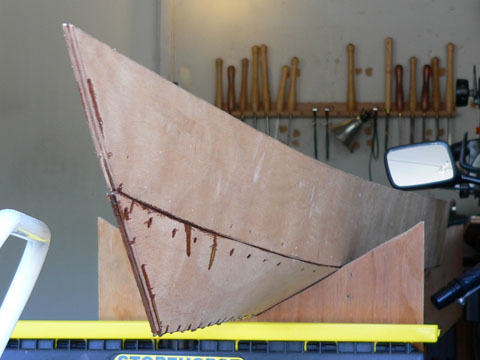
Shows the offset panels. This WAS a mistake.

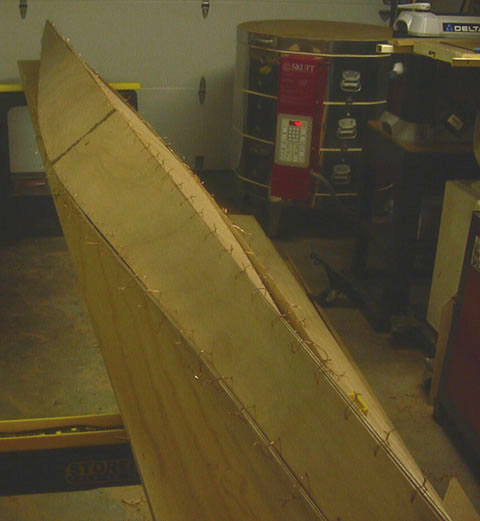
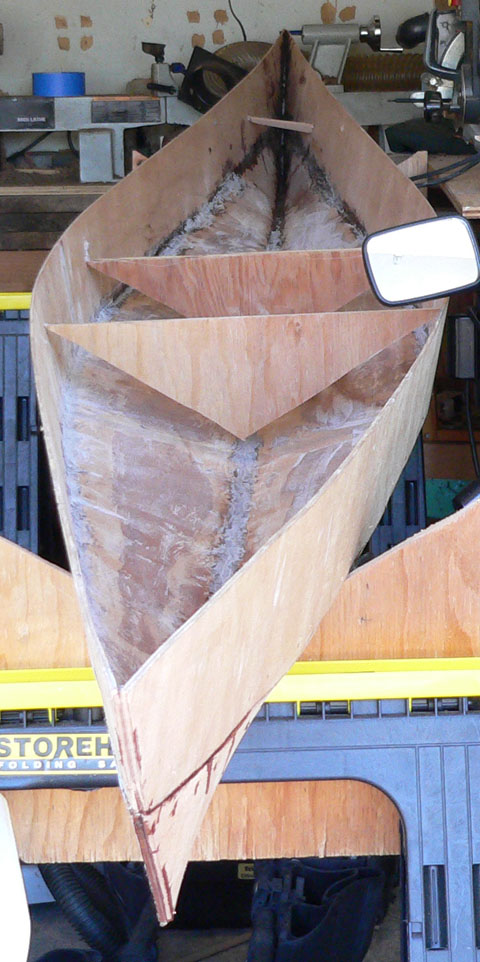
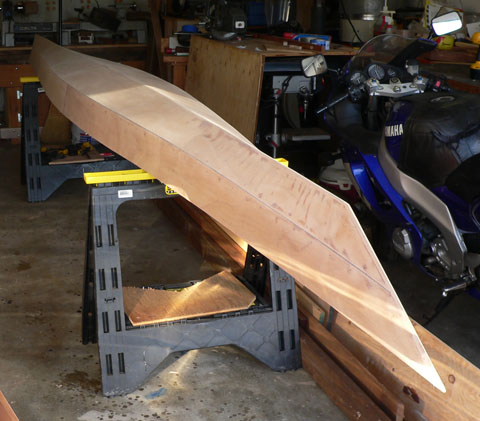
The whole boat stitched together. Notice that it is folding in on itself. Spacers had to be inserted inside to hold the width out to the proper beam measurement.
As an interesting side note, I actually made a mistake in the original stitching which caused the top and bottom sets of panels to be offset at the bow and stern of the boat. This is visible in the detail picture of the bow of the boat. I had to completely unstitch them and do it a second time to correct the problem, but corrected it was, allowing me to move on.
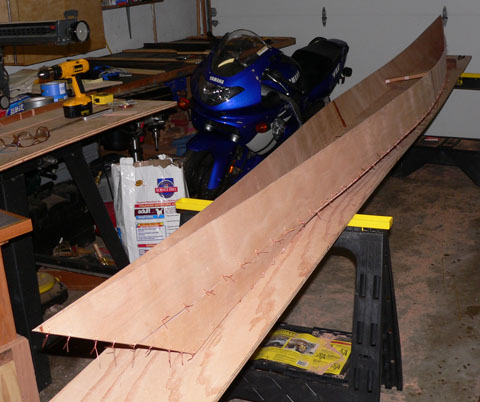
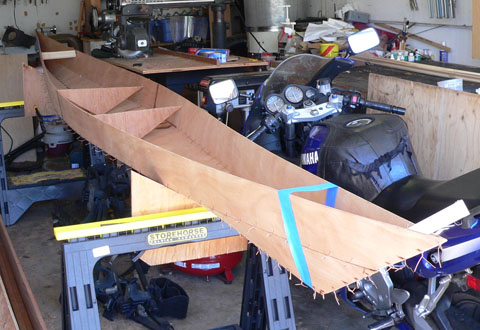
Panels all stitched together. Looks like sort of a boat.

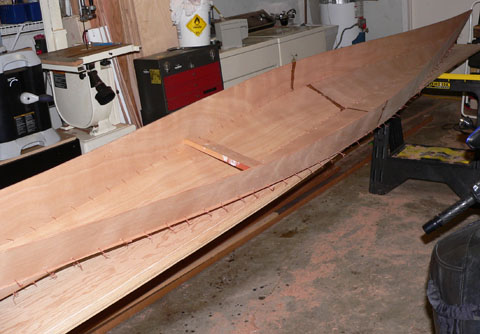
Another shot of the boat all stitched.

The last one.
Once the boat is stitched up and the shape looks good, it's time to glue things up. The first step is to run a line of epoxy down the stitched up seams of the boat. I had to do this in 3 stages, one with the boat on it's keel, another with the boat on one side and then the other. Otherwise the epoxy from the side seams would have run down into the keel line of the boat and wouldn't have done much to stick them together!
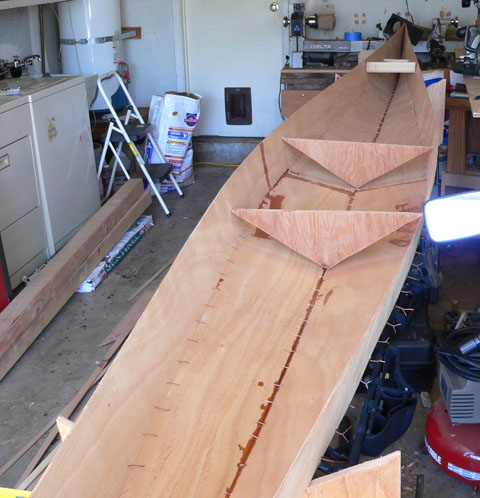
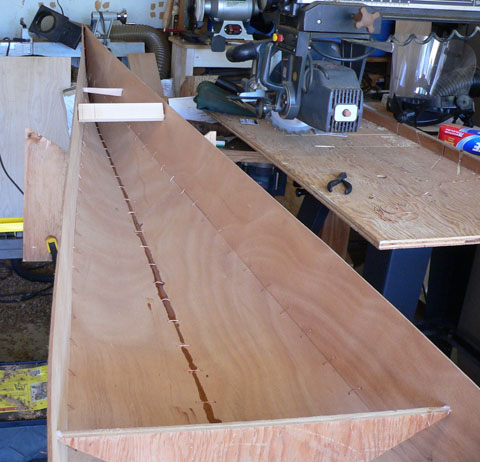
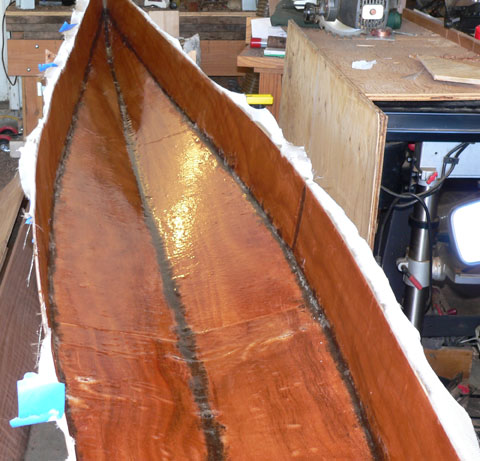
Here is an interior shot with the keel glued up.

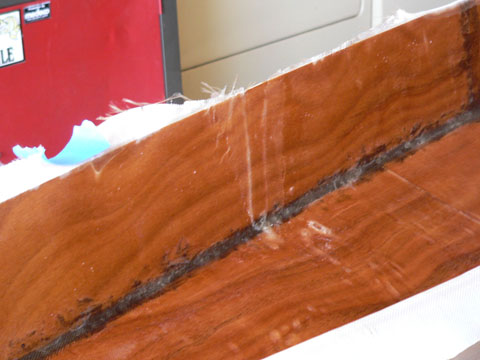
This is another inside shot of the keel showing the glue line running to the bow of the boat.

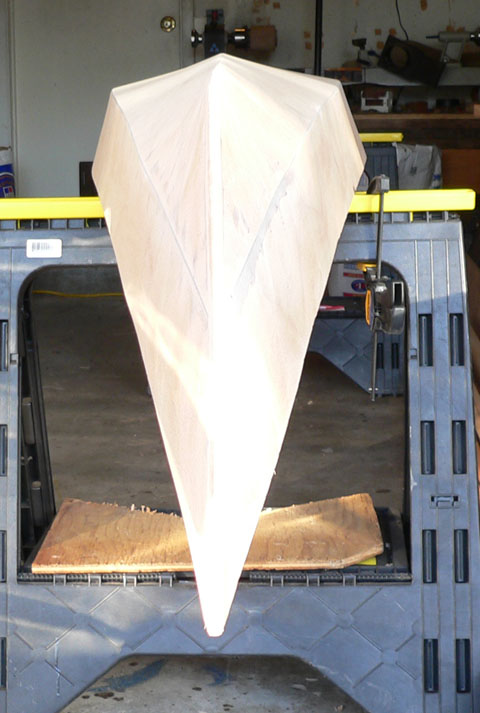
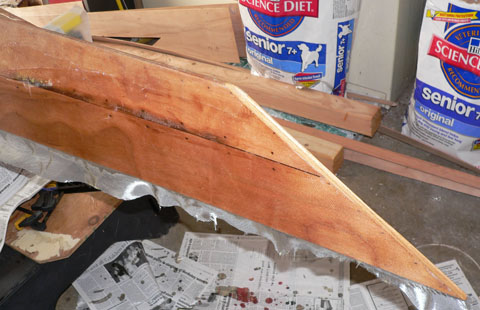
An exterior shot of the bow of the boat. This shot clearly shows the glue that leaked out of the too-wide seams at the bow of the boat.
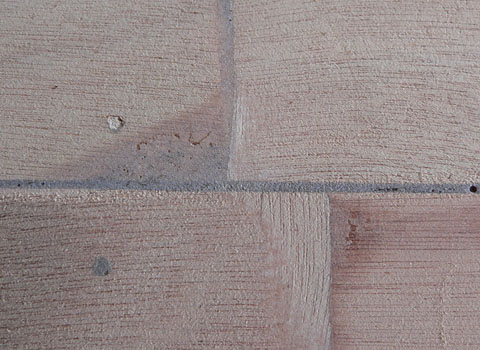
After all the glue dries, it is time to remove the stitches and seal the boat's seams with a layer of thickened epoxy. The recommendation is to thicken the epoxy with wood dust, either purchased for the purpose or simply the contents of a hand sanders dust bag. Unfortunately, I had neither. I figured I'd just grab some of the sanding dust from around my lathe. I got a bunch of it and realized that it was far too course to use for the purpose, so I sifted out the finer powder with a sieve. Sad to say, the resulting dust proved to be far too course to make a smooth mix. I ended up using way too much and sanding it down as well as I could afterwards. Not very good fillets, as these pictures show, but they do the job. I'll do better on the next boat. The fact that the sawdust was from walnut, a far darker wood than my plywood really shows all the elements of construction. I actually think that's sort of cool, so although some would consider it a defect, I consider it a feature.
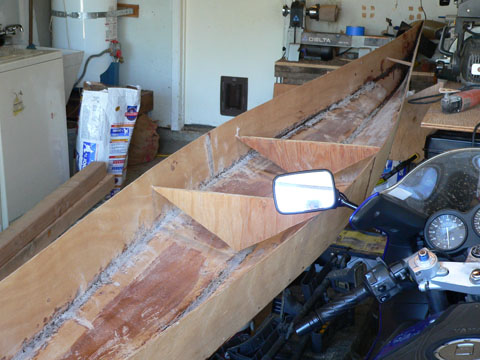
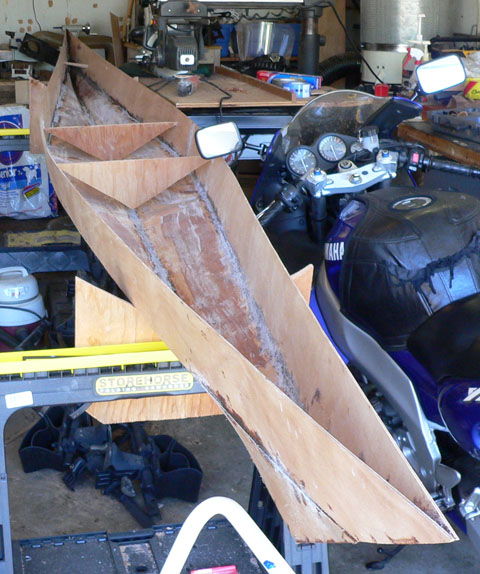
The fillets have been applied. Now I am attempting to smooth them so the glass will lie smoothly on them when I glass the interior of the boat.

More smoothing. I initially used a cabinet scraper to take down the worst of the bumps. I would later finish off with a random orbital sander on the outside of the hull.

Things still looked pretty rough at this point. I could have saved half the weight and work of the filets if I had realizes that one had to use the really fine wood flour. Some designs use fiberglass tape over the seams at this point, but as I intended to glass the entire interior of the boat, I didn't bother.
Once the hull was smoothed to my satisfaction, I wetted it out. I first put down a layer of 4oz fiberglass cloth on the area of the interior that I would be sitting on. The extra reinforcement will help when I pull up on rocky beaches or have to stand in the boat for some reason.
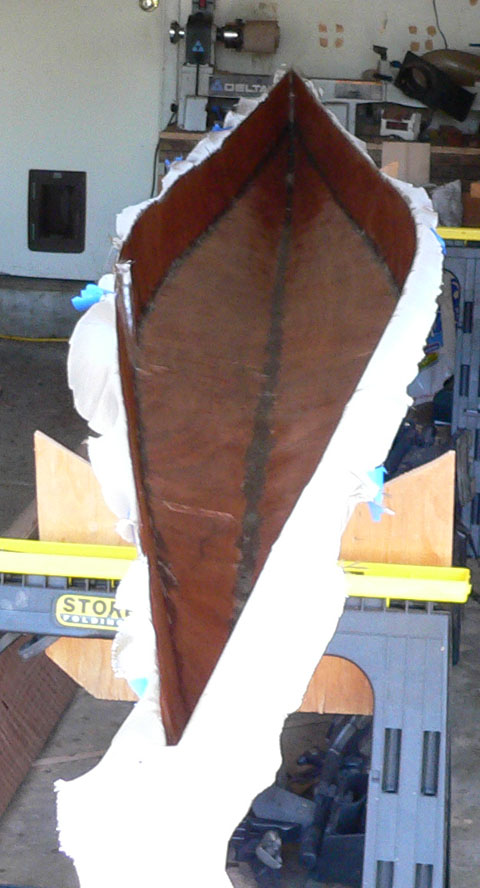
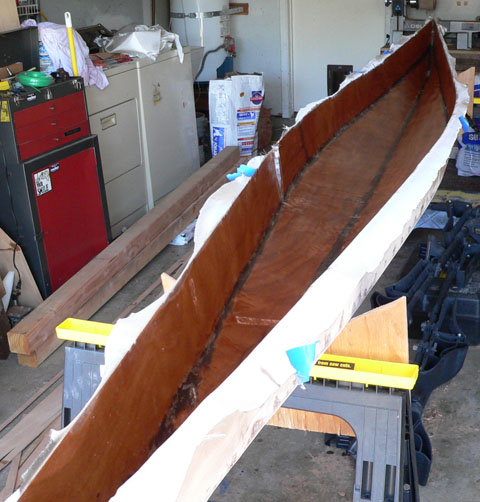
Picture of the hull after the first layer of interior fiberglass cloth is wet out with epoxy.

Another picture of the interior of the hull.

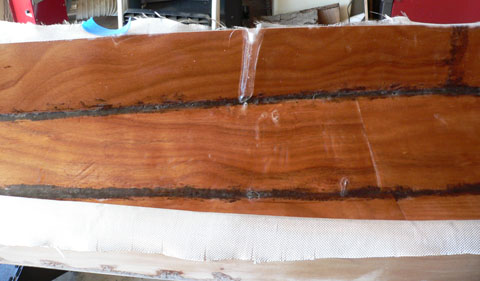
This one shows the seam where the interior layer of glass goes over the reinforcement under the area that will be under the seat.

I made a mistake and left a bubble under the glass along the side of the boat.

To repair the bubble I cut it out and then put another layer of glass over the wound.
Once the inside glass was cured, it was time to clean up the outside for glassing.
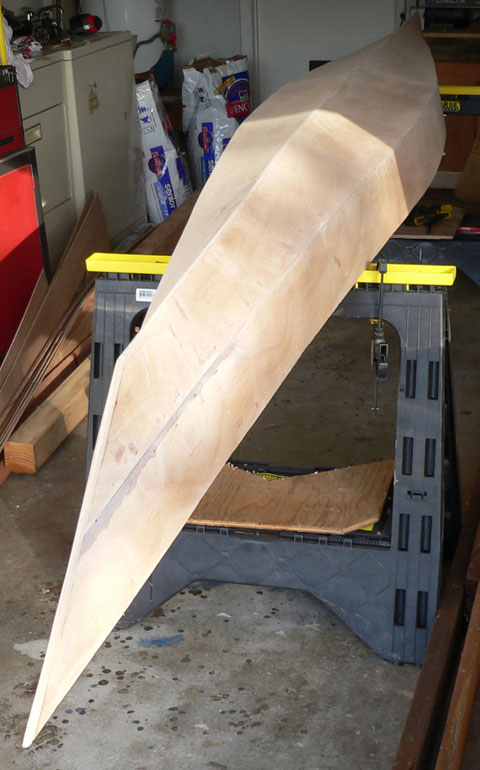
The bow of the boat seen from the left side. The boat had just gone through an extensive sanding.

The bow of the boat after being sanded. Made great effort to make everything really smooth.

The bow of the boat after being sanded. Made great effort to make everything really smooth.

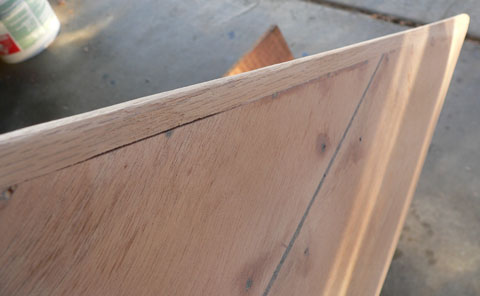
A close shot of the bow of the boat after being sanded. Shows hardwood stems.

A case of over enthusiastic sanding

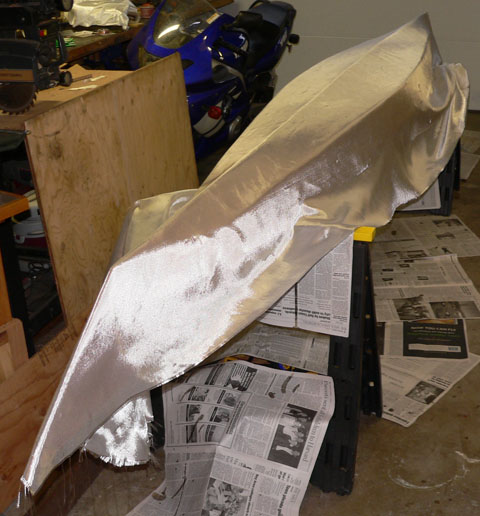
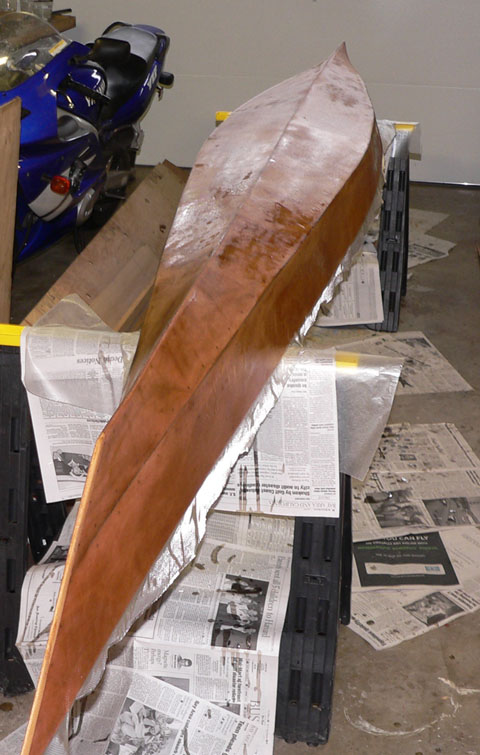
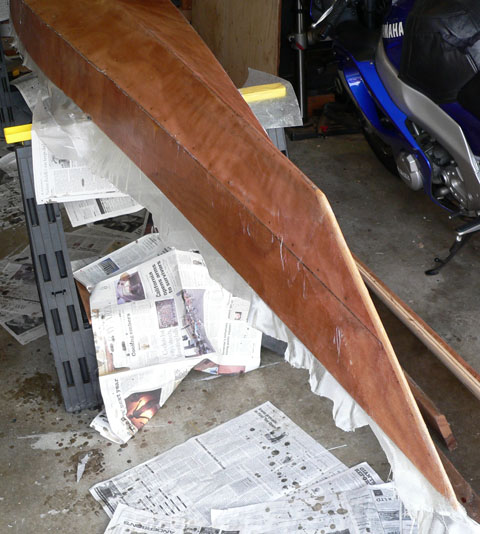
Now the fiberglass cloth is laid over the hull. I laid it on the bias (45% off of the weave lines) so that it could fit better over the curves of the hull. Looks pretty nice all by itself. Once I had it laid out to my satisfaction, I trimmed a couple of inches from the hull bottom and prepared to lay on the first layer of epoxy.

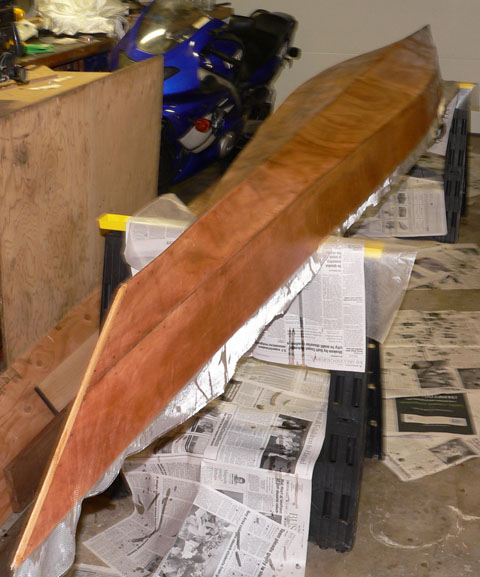
Here is a picture of the hull after the first layer of fiberglass cloth is wet out with epoxy. Took almost 3 hours to do.

Another picture of the hull from the other direction. Nice and shiny!

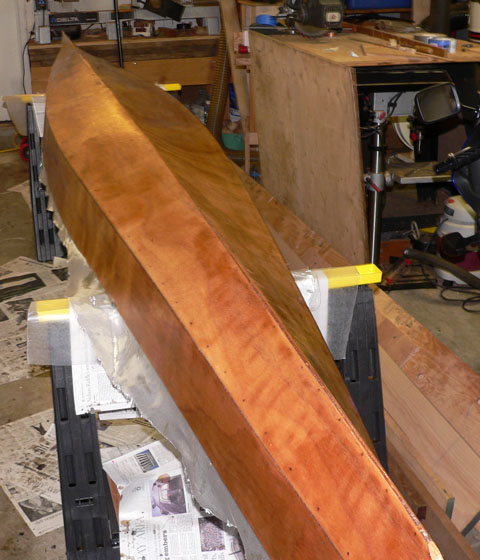
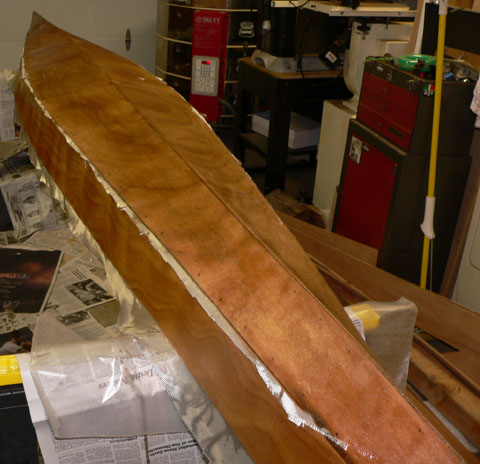
Picture of the hull the next morning after the epoxy has dried. Not quite so shiny anymore. Doesn't look too bad though.

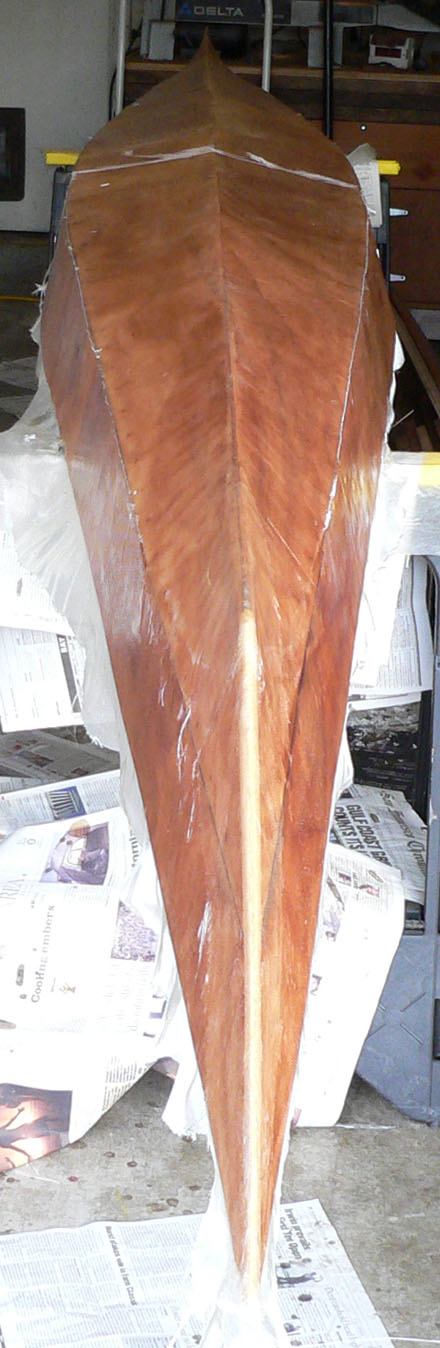
Once the hull had dried enough so that it wasn't tacky to the touch, it was time for a reinforcement layer on the hull bottom. This is called the football area, for obvious reasons if one has seen an America football.

Here's a pic with the extra cloth trimmed off. The edges that are still showing will be sanded off after fill coats of epoxy have been applied to the hull. Everything will be sanded and smoothed at once.

I laid extra layers of glass cloth over the high wear areas on the bow and stern of the boat. I want plenty of material to protect the wood from damage on launches and landings. This is the extra on the stern.

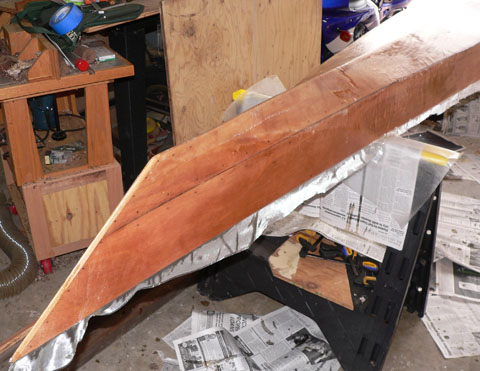
This is the bow of the boat. It tends to take a beating when landing on abrasive surfaces.

Another shot of the bow.

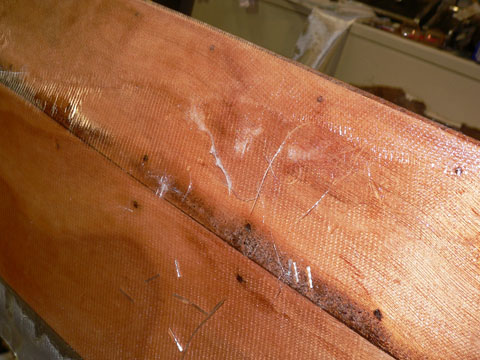
A closeup of the reinforcements patches. The visible fiberglass strings will be scraped away later and will not show on the finished boat.

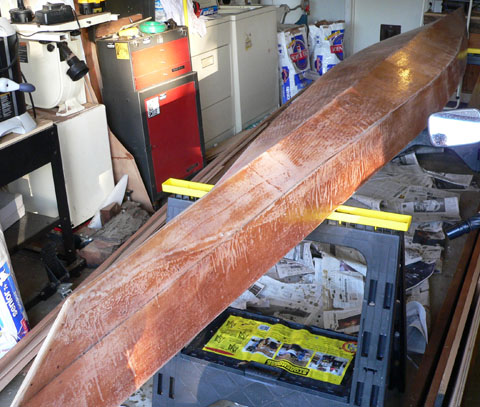
Here's a shot of the hull after the first two fill coats are smoothed somewhat. It will be filled and sanded a couple more times before it's done. Nice to have the hull smooth.

Here's a closer shot of the bow of the boat.

The other side.
I have been planning on making a strip built kayak for quite some time, so I had wood saved for the purpose. I had some nice western red cedar and also some cypress that I had bought while I was working at Woodcraft. I drafted a friend and his table saw, and we cut a couple of boards of each wood into strips that were nominally 1/4" thick. I used them as they came off the saw. It was a big mistake. I will use the planer to bring to exact thickness before I make my next boat. Sanding the high spots down on the boat was a lot of unnecessary work, and I never did get things smooth to my satisfaction.

Now I am putting the forms that I will use to strip the deck into the boat. I just cut them to size and shape and attach them to the inside of the hull with hot glue. The glue doesn't stick too well to the epoxied surface, so will be easy to remove later on.

Here is another pic as I begin to insert the forms.

Now all the forms are in.

Another shot with all the forms in.

I decided to use solid end caps on the bow and stern of the boat rather than trying to make forms for the very ends of the deck. I used some scrap red cedar that I had lying around and sawed them to shape and glued them on with thickened epoxy. This one is on the stern of the boat.

Here is a pic of the end cap on the bow.

A closeup of the bow end cap.

The boat after all the strips have been laid, before removing the staples and sanding.

Another shot showing the lines of staples holding the strips to the forms.

The staples have been removed and sanding of the deck has begun. Patches of thickened epoxy have been applied to the major gaps.

Another shot. The dark areas will be sanded down as the deck is smoothed, and hopefully will not be terribly visible once the deck has been glassed.

A low profile shot. Shows a bit of the deck and the current state of fitting.

The state of the deck after extravagant sanding. The cypress is much harder than the western red cedar, and it's difficult getting the strips level with each other.

Here is the other side of the bow. I'm much more concerned with getting the deck nice than I was with the hull.

A longer angle shot. Once again, from the bow looking in.

The fiber glass cloth has been stretched over the hull and two coats of epoxy applied over it. One more should fill the weave of the glass cloth nicely. This shot is from the stern of the boat looking out.

The bow of the boat. You can see the wet look of the epoxy over the contrasting strips.

A shot of the other side of the boat. Note the waxed paper between the deck and the hull. The keeps the deck and hull from sticking while the deck is glassed.

Wave angle photo of the bow. Starting to look like a kayak!

The inside of the hull has been turned over in the forms and sanded thoroughly.

Note the stretcher sticks holding the shaped of the deck. This is done so that the width of the deck doesn't change as smoothing and fiber glassing take place.

The cockpit area of the deck. Inside view. Note that the deck isn't smooth in some places. My strips weren't the same width, and I had to do way too much thinning in some areas. Going to be a lot of schmutz patches inside here.

A mixture of epoxy, microballoons and sawdust (dookieschmutz) in used to patch dips in the inside deck that I couldn't smooth by sanding.

I put plastic wrap over the patched areas and smoothed them down as best I was able. Makes less work later.

Here is a view of the patches on the bow of the boat.

A long view of the deck. You can see that there were lots of patched areas.

Another show of the bow. You can see that there was a certain amount of mess, even under the plastic wrap.

A bow shot. The hull has been turned over and put back on the forms. A bit of tape holds the whole thing together.

Another bow shot. Yes, I will sand it all and make it look pretty eventually.

A shot of the cockpit cutout template laying on the top of the deck. View from the stern.

Another cockpit template view. Just have to put it in the right place, tape it down and trace. Once that's done, It will be ready to cut out. Stuff doesn't look too bad!

Here is the deck with the cutout for the cockpit. Was scary putting the jig saw into the deck! Seems to have come out OK though.

The riser has been glued on to the deck. This was done by using hot glue to stick the uprights to each other and wood glue to edge glue them to themselves.

Once the glue had set, I trimmed the riser to the approximate height I wanted it. I made a thin mix of epoxy thickened with sawdust and glued it around the joint between the deck and the upright sections of wood to strengthen the joint so that it wouldn't fail while I was doing the next steps. Trimming the riser before creating the cockpit rim made it a bit more difficult to glue the rim on, but kept me from having to worry about getting the correct distance between the combing and the deck.

This is a closeup of the joint between the riser and the deck. Just a thin bead of thickened epoxy is all it took. I actually smoothed it with my gloved finger. Easiest way to make a neat glue joint.

Once the cockpit riser was ready, I soaked a bunch of thin ash strips and glued them around the riser to form the combing rim. Because I planned to reinforce the rim with glass, I used wood glue to glue the strips to each other.

Note the use of many clamps. I ran out of spring clamps and ended up using all sorts of heavier duty wood clamps. Just anything I had. The strips were laid on one at a time. Was a pain, but I think that the results look pretty good and will hold the spray deck securely, which is the idea. Definitely worth it!

Here's a closeup of the forest of clamps that were required to hold the strips tight to the riser as the glue set.

After allowing the glue to dry, the cockpit rim is removed from the riser and cleaned up. Both sides are planed and sanded to create a smooth surface for the sprayskirt to grip.

Now it is time to glue the rim back on the risers. A mixture of thickened epoxy was used to glue the rim on and as you can see, the forest of clamps were once again deployed.

Another view. Notice that spacers were employed between the rim and the deck. This ensured that the rim would be at least high enough for the spray skirt rand to grip.

A closeup of the glue up. It went rather well.

After trimming the top side of the combing, it was time to work on the underside. First I used a small electric saw to cut off the major part of the overhanging cockpit rim. I then used a trim router to clean it up and round the inside over.

Another view of the inside. Even with the routing, it was still necessary to clean up the tight spots by hand. I used a four in hand file, making good use of both the rasp and bastard file portions. Was a lot of work, but eventually everything got contoured pretty well.

After smoothing things, I put a layer of masking tape around the inside edge of the cockpit to keep the glass and epoxy from sticking. I want to bring glass over the cockpit rim and down into the boat from the top, so this is just there to reinforce the joint between the riser and the deck.

Another shot of the same. You can see that the glass isn't really sticking to the tape. To take it off, I'll use a sharp knife to cut the glass around the joint between the tape and the riser. Allows me to peel the excess glass off with the tape.

Here is the inside area with the tape pulled and everything scraped in preparation to flip the deck and start glassing from the other side.

Another shot of the same. Just another angle.

A last shot.